Your brain on slots and the pull of the next spin

Your Brain’s Money Belt
The right and left hemispheres of your brain and mine are connected by a large bundle of nerve fibres called the corpus callosum. It runs from one side to the other, carrying information between them.
Curving above it is another bundle of fibres, the cingulum, whose name comes from the Latin word for girdle. Nearby lies the cingulate cortex. Its front portion, the anterior cingulate cortex in anatomy-speak, is among the regions researchers study when looking at how people respond to gambling outcomes.
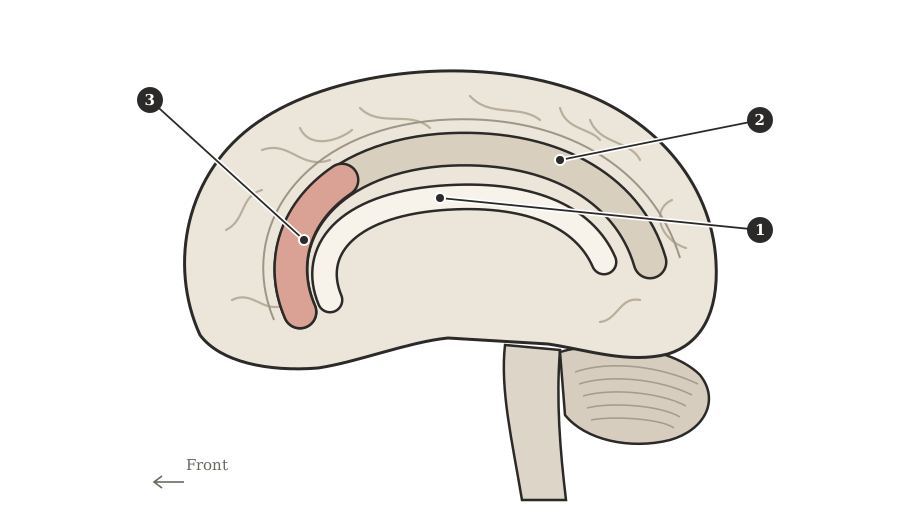
- Corpus callosum
- Cingulate cortex
- Anterior cingulate cortex
I find this location easy to remember because it seems poetically just. A girdle is an ancient equivalent of a belt, and here I am not speaking of grandmother’s type of girdle. So I think of this region as part of the money belt in your brain, involved in weighing what happens when you win or lose.
The image is a useful memory aid, although the brain does not keep its financial affairs in one tidy compartment.
What It Means When a Brain Region Lights Up
We often hear that a particular part of the brain “lights up” during an experiment. The phrase is convenient, but no little lamp switches on beneath the skull.
Brain-imaging methods allow researchers to study signals associated with activity. Functional MRI usually measures changes related to blood oxygenation, while certain PET scans can measure glucose metabolism.
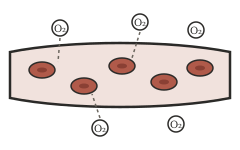
Functional MRI
Measures changes related to blood oxygenation.
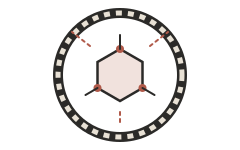
Certain PET scans
Can measure glucose metabolism.
These measurements help researchers examine how different regions respond during a task. They do not reveal a person’s thoughts directly, nor do they show that one region alone is responsible for a complicated behaviour such as gambling.
The Ouch of Losing
A loss can feel sharper than an equivalent gain feels pleasant. Daniel Kahneman and Amos Tversky helped describe this imbalance through their work on loss aversion.
The money belt metaphor gives that feeling a familiar voice. It says “ouch” when money goes, and the player may become preoccupied with getting it back.
That response can take several forms: larger bets, faster play, more credits per spin or a move to a higher-denomination machine. The hope is to repair the loss, but increasing the wager also increases the money at risk.
A small stake can make a slot machine feel less threatening than a large bet at a table. Yet repeated small wagers still add up. The possibility of a large prize does not make the sequence of bets low-risk.
Dopamine and the Pursuit of Reward
Dopamine enters the story whenever researchers discuss reward and motivation. Despite the sound of its name, it does not simply make us dopey, nor is it merely a chemical that delivers pleasure.
It helps the brain learn about rewards and respond to cues that suggest something worth pursuing. The expectation of a reward can matter as well as the reward itself.
-
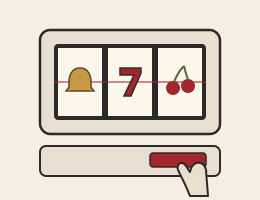 1Starting the spin
-
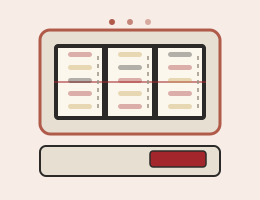 2Waiting for the reels
-
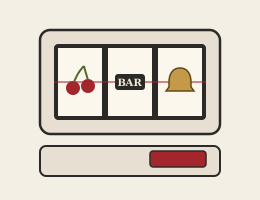 3Seeing the result
For a slot player, that distinction is easy to recognise. The reels are still moving, the result has not arrived, and attention is already fixed on what might happen.
The attraction therefore cannot be measured only at the moment credits appear on the screen. Part of it lies in the pursuit, in the interval between starting the spin and discovering its result.
Weighing the Result
The anterior cingulate cortex is involved in processes such as monitoring outcomes, detecting conflict and adjusting behaviour. Another region, the insula, contributes to bodily feelings, uncertainty and the emotional significance of events.
It is tempting to give each a simple job description. One records the loss; another asks whether the game can be trusted. Such descriptions are memorable, but they are shorthand for work carried out across connected regions.
A disappointing result is more than a number on a display. It can bring a physical feeling, an emotional response and a decision about what to do next, all within a few seconds.
The Difficulty of Letting Go
Letting go is not always easy, whether the object is a possession, an unfinished task or a machine that seems about to pay.
The original comparison with hoarding rests on that difficulty. A person who struggles to part with things might also seem reluctant to leave a machine after investing time and money in it.
But a suggestive comparison is not an established explanation. Hoarding disorder cannot be reduced to low activity in one part of the brain, and it does not tell us how a particular person will behave at a slot machine.
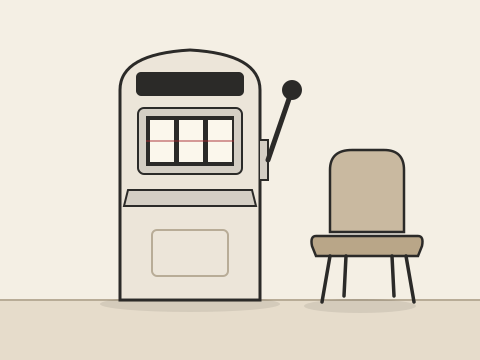
The experience worth considering is the hesitation itself. Should I stay, or should I stop? What if the next spin is the one? A decision that looks simple from across the room may feel anything but simple from the chair.
More Than One Part of the Brain
To be sure, the network in the brain is more complex than these convenient labels suggest. It cannot be reduced to a modern version of phrenology beneath the skull, with a separate patch assigned to every habit.
The orbitofrontal cortex contributes to evaluating outcomes and their changing value. The dorsolateral prefrontal cortex supports working memory and cognitive control. The nucleus accumbens is involved in reward and motivation and receives dopamine input from regions including the ventral tegmental area.
| Region | Role discussed in the article |
|---|---|
| Anterior cingulate cortex | Monitoring outcomes and conflict |
| Insula | Bodily feelings and uncertainty |
| Orbitofrontal cortex | Evaluating outcomes and value |
| Dorsolateral prefrontal cortex | Working memory and cognitive control |
| Nucleus accumbens | Reward and motivation |
| Ventral tegmental area | Dopamine input to connected regions |
These are simplified descriptions. Each region has several functions and works with other parts of the brain.
These structures work with many others. Memory, attention, bodily sensations and expectations all contribute to the experience.
The money belt remains a useful metaphor. But the pull of the next spin belongs to a network, and to a person, rather than to a single spot that lights up.